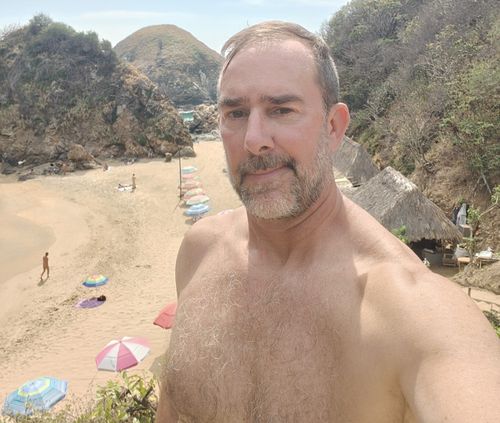
Zipolite is a tiny Pacific Ocean beach town in Oaxaca, Mexico, which has, over several decades, become a niche gay-friendly alternative to larger, more developed resorts like Puerto Vallarta.
Actually, I take that back. It would be wrong—offensive, even—to compare Zipolite, population 1,060, to Puerto Vallarta, which has a metro population of about a half million and an industrial-sized LGBTQ+ Tourism industry.
Zipolite has got a few dozen businesses along a couple of main streets, a winding mountain road and a two-kilometre beach. Many of the venues are mom and pop, some of them dating back to the 1960s. There are no chain businesses, not many structures higher than one storey, and none of the hustle and bustle of a city. A visitor would be hard pressed to buy something like a blender, Bluetooth speaker or a pair of jeans in Zipolite; for anything more than a meal, beer, sunscreen, bathing suits or handicrafts, they’d have to head to the nearest “real town,” an unappealing place called Pochutla, which is about a 40-minute drive inland along a sometimes-frighteningly curvy secondary road. The rocky terrain frames Zipolite’s huge beach, punctuating views with black-grey stone topped with dusty brown-green foliage.
For those who love doing nothing but sitting in a hammock, reading by the ocean, taking long walks on the beach, eating local cuisine, drinking beer and flirting, and perhaps hooking up with fellow gay visitors, Zipolite will scratch a particular itch. For those who love to do all this while naked, all the better. Zipolite’s history as a nudist-friendly destination goes back to the 1960s, when hippies took a liking to the place and locals decided they’d put up with their habit of sunbathing in the nude.
Gay men, both Mexican and international, started coming to Zipolite in the 1980s, but the numbers were very small until the 2000s. In the 2010s, Zipolite started being more serious and less discreet about being nudist-friendly, launching a nudist festival, which usually happens in early February, and fully legalizing beach nudity in 2016. Until then, authorities had merely turned a blind eye to naked visitors. After that, the number of gay visitors, and nudists more generally, started increasing dramatically.
Most businesses in Zipolite are gay-friendly—the locals have seen it all and then some. Most of the hotels and restaurants are cheap and cheerful. One regular will have their favourites, another will love others. Since the 2010s, a growing number of businesses have been catering to gay men. This guide will focus on these gay-focused businesses, as well as businesses that stand out as being a bit more unique, including those that permit nudity. Everything else is best left to whim and serendipity. Zipolite is not a place you want to make plans or reservations.
How to get there
Zipolite is a remote destination in one of Mexico’s poorest states. Set aside expectations you might have set in Puerto Vallarta, Cancun, Punta Cana, Montego Bay or the like.
There are two airports within roughly 90 minutes of driving distance from Zipolite: Puerto Escondido and Bahías de Huatulco International Airport. Huatulco, which serves the mid-priced mainstream resort area of the same name, is a little closer and has more international flights, though many of them are charter flights and therefore seasonal.
Inside each airport there are desks selling pre-paid taxi rides to Zipolite, where the price starts around 1,500 pesos (roughly US$95, CAD$120). Those who find that steep can walk a few minutes from the airport and negotiate with the taxi drivers who usually hang out by the gates; they might be bartered down to around 1,000 pesos and might also help round up two or three other people to share the cost. Shared taxis will drop you near, but not necessarily at, your hotel.
Those who want to forego taxis altogether—this is backpacker country, after all—can continue walking or taxiing the short distance from either airport to the main road (highway 200), where buses regularly traverse the main highway between Puerto Escondido and Huatulco airports. You can often flag them down, but they also have designated stops. About 60 pesos gets a bus ride to the one of the turnoffs to the secondary road (the 175), a coastal loop off 200, that leads to Zipolite. From the intersection, a traveller can catch a colectivo—a licensed truck that follows a regular route along 175 collecting and dropping off passengers for a fixed rate, usually a couple of bucks a ride.